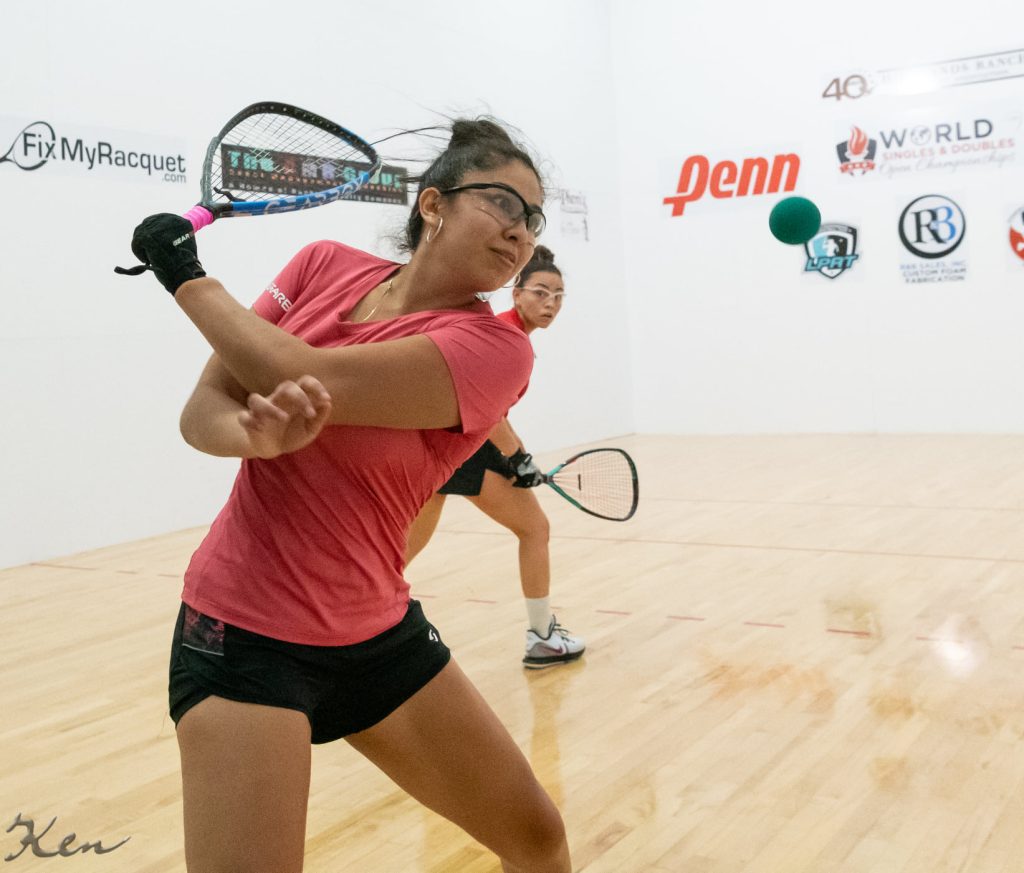
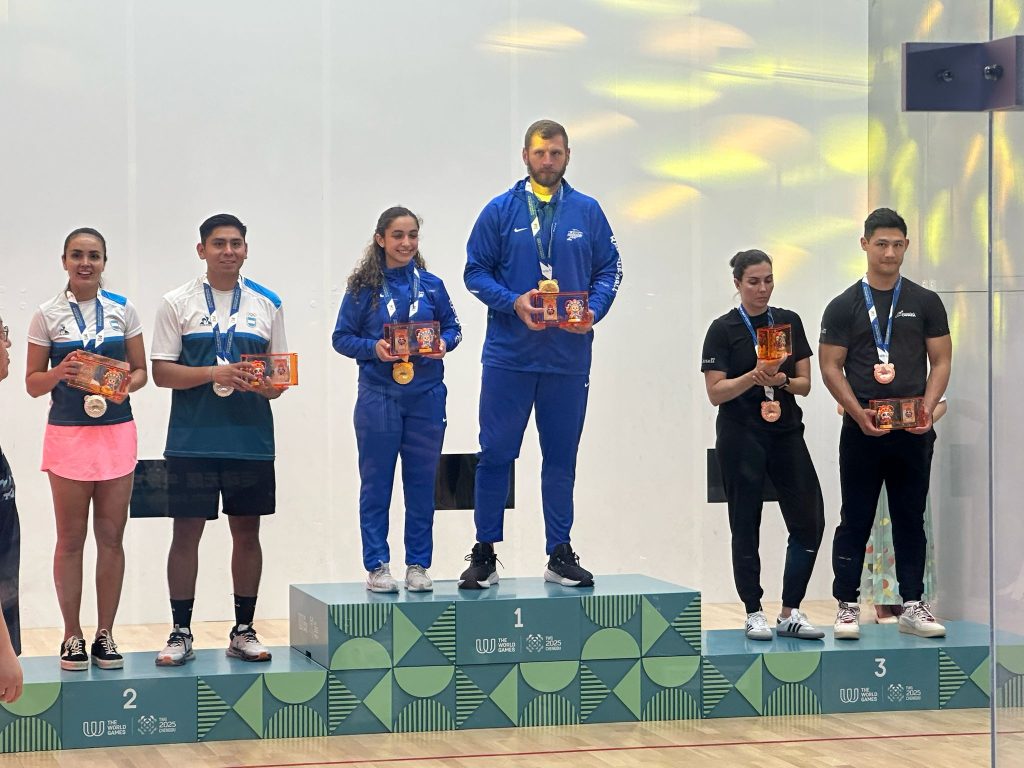
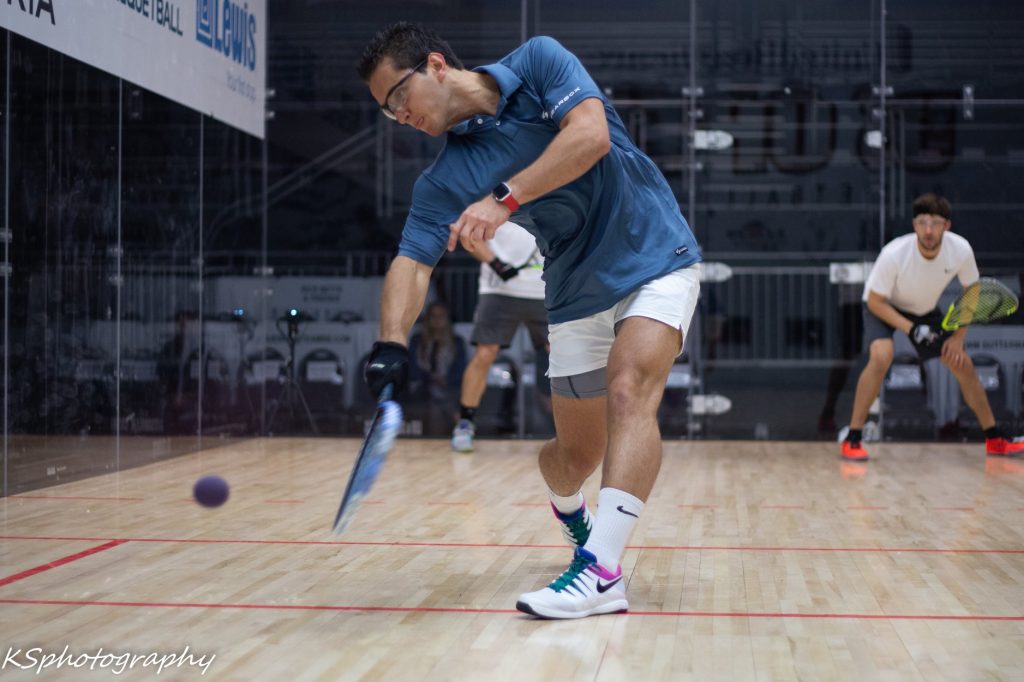
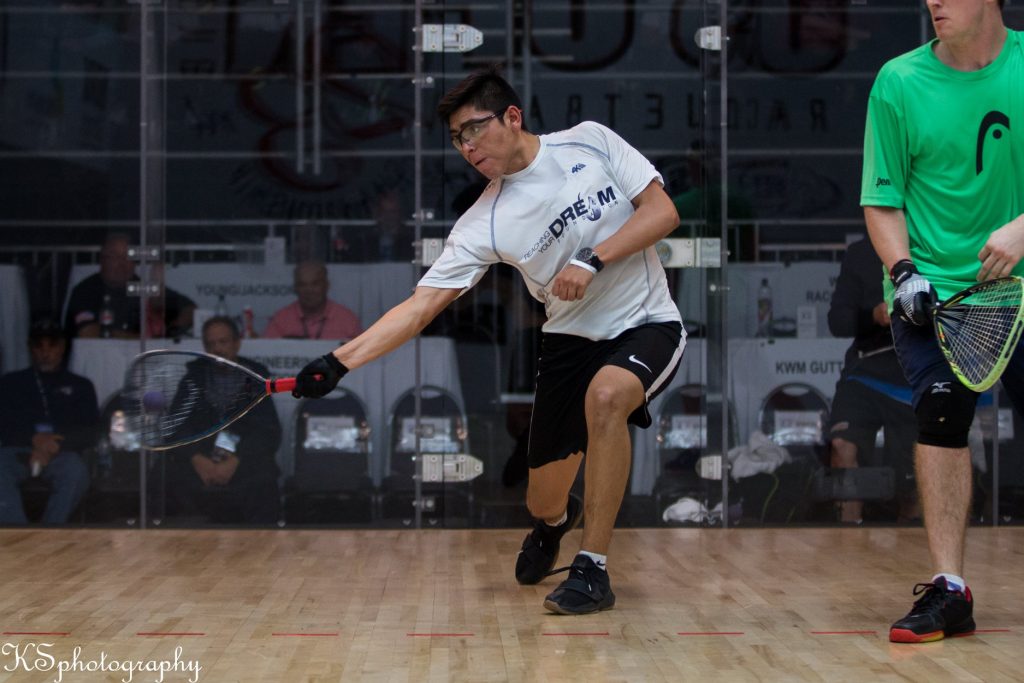
Vargas wins twice and powers Argentina to the team win. Photo via usaracquetballevents.com
The @iInternational Racquetball Federation – IRF hosted the racquetball component of the 2026 South American games this week, just the 4th time that this regional competition has hosted the sport.
The South American games were created way back in 1978 and serve as a regional Olympic-style sports competition for just the countries of that continent. Thi
Racquetball first made its way into the competition in 1998, the 6th iteration of the event, but the results of that tournament are lost to history. It did not return until 2007, when the IRF held an out of cycle event in Ecuador. Then the sport was omitted for the next couple of events, returning in 2018 when the event was held in racquetball-crazed Cochabamba, Bolivia.
This past weekend technically is thus the 4th time the sport has bee included in the 13 iterations of the event, and once again the host city/country seems to play a part, since Argentina is hosting this year’s competition.
Five countries participated: Argentina, Bolivia, Chile, Ecuador, and Peru. Despite efforts to relaunch Colombia’s NGB, there were no Colombians here, nor players from other SA countries that have sent representatives internationally in the past like Venezuela and elsewhere.
In the end, as one might expect, the competitions all ended up being Bolivia vs Argentina in the latter stages, technically being Bolivia versus “players who were all born in Bolivia but who now play for Argentina.”
here’s a quick recap:
Congrats to the champions:
Men’s Singles: Conrrado Moscoso Women’s Singles: @Maria Jose Vargas Men’s Doubles: Conrrado Moscoso & @Kadim Carrasco Women’s Doubles: Maria Jose Vargas & @Valeria Centellas Mixed Doubles: @Diego Garcia & Natalia Mendez V.
Argentina takes 3 of the five draws against its rival Bolivia to “win” the event.
PRS links to draws in the database: Men’s Singles: https://rball.pro/6b326d Women’s Singles: https://rball.pro/ed5c01 Men’s Doubles: https://rball.pro/cef63f Women’s Doubles: https://rball.pro/cef63f Mixed Doubles: https://rball.pro/3f1835
Men’s Singles: The group stage was chalk, and the best match of the competition was probably the semifinal between Flores and Garcia. Flores took it 11-9 in the fifth, but it was yet another reminder that we need to see Garcia on the pro tour more regularly. I have a hard time not believing he’d be pushing for a top 5 spot if he made 100% of the events. In the final, Moscoso remained undefeated against his countryman across Amateur, IRF, and IRT events with a 3-game win.
Women’s Singles: Bolivia has seen a bit of a gap in its top women’s competitors thanks to Barrios’ knee injury; their representatives here were Camila Rivero and Valeria Miranda Martinez, who both fell to LPRT regulars in the knockouts. Rivero is the 3-time defending World Junior 21U champ but who has only a handful of pro tourneys under he belt; she lost in the semis to top-8 pro Mendez in five. Vargas cruised past her country-woman and now former doubles partner Mendez in the final.
Men’s Doubles: Ecuador’s Ugalde & Cueva was the top seed here thanks to their making the semis at PARC earlier this year (the highest finish of any South American country), and they finished 2nd in the group stage to the powerhouse Bolivian team of Moscoso/Carrasco. Argentina was missing Gerson Miranda, leaving the veteran Kurzbard playing along side Diego Garcia. The Argentines avenged a group stage loss to Ecuador in the semis of the knockouts, but then took a heavy loss to the Bolivians in the title game.
Women’s Doubles: It was Argentina and Bolivia 1-2 in the group stage, and then 1-2 in the final. Rivero teamed with long-time Bolivian veteran @Jenny Daza to press the Argentines in the final to 5 games, but they ultimately fell.
Mixed Doubles: The power of Flores could not push team Bolivia over Argentina, as Mendez outhit Dava one the right-hand side to make the difference in both their group stage and in the gold medal match.
——————
For the rest of the weekend’s competition, the players are all playing “team” competitions.
Herrera wins her first ever International singles title. Photo Denver 2021 KenFife
The IRF hosted its recurring Central American & Caribbean Games, returning to the Dominican Republic for the 2026 iteration of the event.
This is the 10th iteration of these games that have had a racquetball component. The first one was in 1990, when Mexico hosted the event and its two singles components were won by Raul Torres and Hilda Rodriguez of Mexico, two very early pioneers of Mexican racquetball. In fact, Mexico has always dominated this competition, winning 12 of the previous 16 singles titles and sweeping all 5 titles in the 2023 version.
Countries participating this year: host Dominican Republic, Mexico, Costa Rica, Guatemala, Honduras, Venezuela, and Cuba. Venezuela is an odd entry, as they are in neither Central America or the Caribbean, but hey I don’t make the rules. It is not the first time a South American country has bee included in this event. Heck, in 2018 Colombia HOSTED this event. I’m not entirely sure why Mexico is in this event year after year; they’re regularly included as a “North American” country, but I was a Math major, not Geography, so don’t listen to me.
Congrats to your winners on the weekend:
– Men’s Singles: Rodrigo Montoya
– Women’s Singles: Alexandra Herrera
– Men’s Doubles: Eduardo Portillo/Andre Parrilla
– Women’s Doubles: Montse Mejia/Alexandra Herrera
– Mixed Doubles: Andres Acuna/Larissa Faeth
Exec Summary: Mexico wins 4 of the 5 titles, but 15yr old Faeth gets another win for Costa Rica’s Adult team internationally.
R2 Sports App home page for event: https://www.r2sports.com/website/event-website.asp?TID=54300
Match Reports in the PRS database post-load:
– Men’s Singles: https://rball.pro/18bf6e
– Women’s Singles: https://rball.pro/8dc8e2
– Men’ Doubles: https://rball.pro/9544e2
– Women’s Doubles: https://rball.pro/45b3f5
– Mixed Doubles: https://rball.pro/2bcd18
——————
Lets review the five main draws, calling out upsets and interesting results.
Men’s Singles:
The group stages were nearly 100% chalk, and with very few matches that even went beyond three games. The best match of the group stages was probably to determine 1st place in Group D, as Costa Rica’s Gabriel Garcia took out Guatemalan veteran Juan Jose Salvatierra in four close games to secure the #4 seed in the knockouts.
In the knockouts, the host Dominicans played well, with Luis Perez taking a game off of #1 seed Portillo in the quarters, and Dominican #1 Ramon De Leon upsetting Guatemala’s Garcia to reach the semis. Portillo had to go 5 games to top De Leon to make the final from the top, while two IRT top-10 players in Rodrigo Montoya and Andres Acuna battled it out from the bottom half, with Montoya advancing to return to the final. In a rematch of the 2023 final, Montoya blitzed Portillo 4,4,6 for the gold. It is first CAC singles gold, and his 4th career International gold medal.
——————–
Women’s Singles:
The group stage was mostly without incident; the two Costa Rican women entries were probably slightly overseeded thanks to their performance in the most recent Int’l event, and both were “upset” in the group stage. This gave Venezuelan veteran Marina Tobon the 4th seed in the knockouts, where she was summarily upset by Dominican Maria Cespedes in the quarters.
The biggest upset of the tournament though was from Costa Rican 15yr old Larissa Faeth, who upset the 3rd seeded Montse Mejia in four games. Faeth, who is the two-time defending 14U world Junior champion, is now regularly representing Costa Rica in Adult competitions and advanced to the semis here before falling.
In the top semi #1 Alexandra Herrera cruised past Cespedes in three, while from the bottom half Guatemala’s Gaby Martinez ended Faeth’s run in three, setting up a top-10 LPRT final between two old rivals. In the final, Herrera got her first ever IRF win over Martinez to claim her first ever International singles title.
——————–
Men’s Doubles:
A chalk group stage led to a 7-team knockout round with two heavy favorites … and one of them got upset in the semis. Costa Rica’s all-Acuna team of brothers Andres and Sergio got upset by the Guatemalans Salvatierra & Aldana in the semis to setup an unlikely final. In the gold medal match, team Mexico blitzed Team Guatemala to keep it an all Mexico gold affair.
——————–
Women’s Doubles:
The entire Women’s doubles draw went chalk, in both the group stage and in the knockouts. Top seed and defending champ Team Mexico was represented by Herrera & Mejia, one of the best doubles teams in the history of the sport and winners of dozens of titles both internationally and professionally; they advanced to the final from the top half. From the bottom half, long-time Guatemalan partners Gaby Martinez and Maria Renee (Rodriguez) Josey also cruised into the final to face off. In the final, Team Mexico made it 4-for-4 with a 8,4,8 win over the Guatemalans.
——————–
Mixed Doubles:
An upset free group round set the stage for the two top seeds (from Mexico and Costa Rica) to meet, but both were pushed before they got there. Team Costa Rica (featuring top-4 IRT player Andres Acuna and 15-yr old phenom Larissa Faeth) had to dig deep to top the Cubans in one semi, while team Mexico (featuring Rodrigo Montoya and Jessica Parrilla) got pushed to 5 games by team Guatemala before advancing. In the final, the top seeded Costa Rican team won their second straight IRF event, following up on their gold together in the PARC event in March, with a solid 4-game win over team Mexico. The 15yr old Faeth held her own along the right against veteran pro Parrilla and they got the win.
——————
The players will remain in the DR for a couple more days playing a Team event before heading home.
Next up on the calendar is the 2026 Mexican Junior Nationals next weekend. There’s an IRT-600 satellite event later in the month. Sometime in early August, look for Season in Review articles from yours truly recapping both the IRT and LPRT seasons.
Vargas wins the double in Guatemala. Photo via usaracquetballevents.com
The singles and doubles competitions for the 37th annual Pan American Racquetball Championships tournament are in the books. Here’s a recap of the group and knockout action, along with links for the results as entered into the Pro Racquetball Stats database.
Congratulations to the winners:
– Men’s Singles: Conrrado Moscoso , Bolivia – Women’s Singles: @Maria Jose Vargas, Argentina – Men’s Doubles: @Rodrigo Montoya Racquetball / Javier Mar, Mexico – Women’s Doubles: Maria Jose Vargas/Valeria Centellas, Argentina – Mixed Doubles: @Andres Acuna/Larissa Faeth, Costa Rica
Executive Summary: The favorites survived a crazy singles competition full of surprises and early upsets, with Moscoso beating Portillo on the Men’s side and Vargas topping Gaby in the Women’s singles final. Costa Rica’s mixed team won the title featuring the precocious Faeth alongside top IRT pro Acuna in a huge upset.
Pro Racquetball Stats DB match results. Click on these links to see the match results in the DB:
PARC now includes a “Team Competition” where the countries compete against each other at the end of the individual competitions, which is going on as you read this for the next couple of days, but for decades the “Team Standings” were determined by an algorithm that awarded points based on group stage and knockout performance. I’m unclear whether IRF continues to name “team winners” in this same way, but here’s the team results using the historical methods, which I also enter into the database for consistency across IRF events back to the beginning.
(You can get these “team results” via queries available from the IRF singles page off of proracquetballstats.com for past history)
If you’d like to see the worksheet that calculates these points, see here: https://docs.google.com/spreadsheets/d/1SblLg5EbQ2KzXOmKHqxg-9iPPSMytmbH46Ay5hYJzZU/edit?usp=sharing
—
Combined Team (Overall)
1st — Mexico 2nd – Argentina 3rd – Bolivia 4th — Costa Rica
Summary: Mexico’s overall performance dwarfed even 2nd place Argentina as it reasserted its dominance after getting pipped by Bolivia in competitions lately. USA dips to an embarrassing 7th in the team points competition.
Summary: USA out of the top four after poor singles results really cost them points, while Mexico dominated on the men’s side, with a win and a final in doubles and singles respectively. Despite missing Flores, Bolivia finished in second.
Women’s Team
1st – Argentina 2nd – Mexico 3rd – Guatemala 4th – Bolivia & Costa Rica tied
Summary: a double by Vargas powered Argentina to a clear win here. Once again, the USA is out of the top 4.
——-
Let’s run through the individual draws and talk about notable results.
Men’s Singles:
In the group stages, not too many major surprises or upsets. Argentina’s Diego Garcia beat Jake Bredenbeck to take their group but that’s not too much of a surprise upset. Bolivian 16U player Sebastian Borja lost in 5 to Argentina’s Gerson Miranda to lose the group, but that’s also as expected. The biggest RR upset may have been Canada’s Coby Iwaasa taking out Alan Natera, but again not too big of a surprise as Iwaasa is one of the best players in the world who never really played the pro tour regularly.
In the knockouts, massive upsets early. Borja took out Garcia in the 16s; he was the champion in this event last year. Iwaasa then took out Andree Parrilla; that’s two IRT top 10 players beaten for the Canadian. Lastly, Sam Murry took out No. 3 seed Gerson Miranda in a huge seeding upset, but probably an expected result based on the head to head matchup. All told, 5 of the top 8 knockout seeds were beaten in the first round.
16yr old Borja more than held his own, making the semis and losing to his own countryman Moscoso. Murray topped Acuna but couldn’t get past Portillo, giving the draw a 1v2 final despite all the carnage earlier. In the final, Moscoso dropped the first game but won the match in 4 for his 7th international title.
—
Women’s Singles:
Four of the five RR groups were straight forward, and then we had Group 4 with this quartet of players: Natalia Mendez, Annie Sanchez, Gaby Martinez, and Camila Rivero.
Editorial tangent: If there was ever a better argument for more intelligent seeding at IRF events, this is it. That’s two LPRT top 6 players in Mendez & Martinez, the current #12 LPRT player in Sanchez, and the 3-time defending 21U Junior world champ Rivero. Come on. In a competition that included, not to name names, literal B- players from lesser countries why would you stack a group like this? In the end, the players all beat up on each other, Sanchez went 0-3 and Mendez went 2-1 but finished 3rd on point differential to be omitted from the knockouts despite currently being ranked #5 on tour.
In the knockouts, the four top-ranked players in the competition all advanced to the semis as expected. There, Gaby took out Herrera and Vargas took out Mejia to get a solid final, where Vargas won and claimed her 5th career IRF singles title.
—–
Men’s Doubles.
No surprises in group stages, and all 13 entered teams advanced to the knockouts. There, the lack of Bolivia’s top team showed out, as they threw out two juniors who couldn’t do much with the powerful Canadian team. It probably didn’t matter, as the lopsided country-based seeding and the weird collapse of the Argentinian team cleared the way for Murray & Iwaasa to make the final. The bottom half was stacked, featuring Mexico, USA, and Costa Rica, but the Montoya/Mar juggernaut persevered and setup a dream final.
In the final, Montoya & Mar won a 5-game battle to claim their 5th career IRF doubles title together.
—-
Women’s Doubles:
No surprises in the group stage. In the knockouts, the powerful Argentine team of Vargas & Centellas outlasted a great push by the young Bolivian team of Rivero & Amaya to get to the final. In the stacked bottom half, Guatemala sent USA home early in the quarters but then fell to Mejia & Herrera in the semis. The Mexican pair, who has dominated Women’s doubles for years on tour, was upset in the final by the Argentine pair.
—-
Mixed Doubles
Perhaps the most wide open draw in the event was the Mixed Doubles event, which featured a number of teams who have had past success. Last year’s champs husband/wife pair of Natera & Munoz were knocked out in the semis by Bolivia’s Moscoso & Amaya, who then fell to Costa Rica (sporting the 16-yr old Larissa Faeth more than holding her own in this competition). In the final, Acuna & Faeth shocked the world with a win over Argentina’s Miranda & Mendez to claim CR’s second ever international title.
——
Commentary on the State of the PARC and International competitions
The 2026 PARC competition saw the return of a team from Colombia after several years away (their federation collapsed, causing stalwart Colombians like Cristina Amaya to decamp for other countries). We also saw Venezuela send a time for the first time in years, along with players from Cuba (who missed last year), Puerto Rico, and Peru. In fact, the only regularly attending country missing this time around was Honduras. So, that’s good to see.
Four of the countries however didn’t send any females at all (Ecuador, Cuba, Peru, and PR). Peru and PR’s attendees may have been completely independent/self financed, but the other two federations should have sent full teams.
Bolivia continues to be plagued by financial support issues, which cost them the attendance of Jhonathan Flores and any of their top females … instead he was replaced by their reigning 16U world champion Borja in singles and by two other youngsters (Aldin & Aguilar) in Men’s doubles, plus a female in Amaya who doesn’t even have any junior results, which likely cost them a shot at the overall team titles. They held their own .. but if international competitions are so important to the Bolivians, perhaps they should figure out how to support their teams.
——
Congrats to the International Racquetball Federation for another successful event. Thanks to the IRT streaming crew, and thanks to @Gary Mazaroff and all his co-announcers for their hard work all week.
Next up on the Racquetball Calendar: the IRT is back in action in Fountain Valley in two weeks’ time. Plus, I hear we may have an LPRT event in the making before the season ends.
Camila Rivero continues her dominance of World Juniors 21U, winning her third straight title. Photo via deportes de Bolviia
So, I’m a little behind on this one. World Juniors was in mid December in Santo Domingo, Dominican Republic, and to be completely honest the timing of the event along with the timing of other events I cover, as well as a mid-December work trip and then mid-December holiday travel completely conspired against me having any shot of doing the massive amount of work required to enter the data for World Juniors, nor to recap it until now.
However, this is one of the most important events of the year to cover, because it’s often the first time we hear about top-level juniors coming from Bolivia and Mexico who might suddenly start getting wins in the pro tours. It’s also a great way to see how the other leading countries’ juniors are stacking up.
So, with that said, lets recap. We’ll list all the singles winners, then do some quick narrative discussion by division.
Here’s the “matrix reports” of Boys and Girls Junior Worlds champions historically:
– Boys: https://rball.pro/ff5caa
– Girls: https://rball.pro/t6e
Champions were crowned in Singles, Doubles, and Mixed Doubles in six age groups: 21U, 18U, 16U, 14U, 12U, and 10U, as well as a team competition, meaning that in essence this tournament actually held 30 separate competitions. All 30 competitions are now in the database; If you see any typos, or name corrections, please don’t hesitate to reach out.
Reminder: as a practice, Pro Racquetball Stats does not capture full draws for any groups younger than 14yr olds; for the 12s, 10s, and younger we just capture the champions for historical reporting. Junior Doubles only has the gold medal match, not the full draws. If you’d like to see more data than this for juniors in the database, reach out and I’ll guide you on doing data entry.
Congratulations to your 2025 World Junior champions:
Boys Singles:
– Boys 21U: Jhonathan Flores, Bolivia
– Boys 18U: Marco Mamani Aguilar, Bolivia
– Boys 16U: Santiago Borja, Bolivia
– Boys 14U: Hanz Vega, Bolivia
– Boys 12U: Max Soto, Mexico
– Boys 10U: Damian Gracia Castro, Mexico
Summary: Bolivia takes 4 of the 6 Boys titles. Not one final included a player from outside Bolivia & Mexico. Furthermore, and even more shocking, there was just one player from outside Mexico/Bolivia to even make the SEMIS in any of these draws. The dominance in World Juniors of these two countries is unlike anything we’ve seen since the old days, when every final was a rematch of the USA Junior National finals.
Girls Singles:
– Girls 21U: Camila Rivero, Bolivia
– Girls 18U: Yanna Salazar, Mexico
– Girls 16U: Luciana Illanes Quenta, Bolivia
– Girls 14U: Larissa Faeth, Costa Rica
– Girls 12U: Mary Hinojosa Garcia, Bolivia
– Girls 10U: Briana Ampuero, Bolivia
Summary: Bolivia takes 4 of the 6 Girls Singles titles, and we get the first singles titlist from outside the big two countries.
———————
Boys Doubles:
– Boys 21U: Sebastian Hernandez/Jorge Gutierrez, Mexico
– Boys 18U: Eder Renteria/Diego Romano, Mexico
– Boys 16U: Santiago Borja/Sebastian Terrazas, Bolivia
– Boys 14U: Alejandro Robles Picon/Elias Medrano, Mexico
– Boys 12U: Max Soto/Hermann Gracia, Mexico
– Boys 10U: Juan Ignacio Morales/Benjamin Lino Daza, Bolivia
Summary: Mexico takes 4 of the 6 Boys doubles titles, while Bolivia takes the other two. There’s some penetration from other countries into the back ends of the doubles draws, but it continues to be Mexico/Bolivia dominated.
Summary, as in 2025, Bolivia takes 4 of the 6 Girls doubles titles, while Larissa Faeth leads the charge for Costa Rica to break through the Bolivia/Mexico dominance.
Mixed Doubles:
– Mixed 21U: DJ Mendoza/Naomi Ros, USA
– Mixed 18U: Nicolas Galindo / Yanna Salazar, Mexico
– Mixed 16U: Santiago Borja/Suszel Andrea Pairo , Bolivia
– Mixed 12U: Dylan Zambrana / Mary Hinojosa Garcia, Bolivia
– Mixed 10U: Benjamin Lino Daza / Briana Ampuero, Bolivia
Summary: Bolivia takes 4 of the 6 Mixed doubles titles, all of them the youngest of the six. Team USA gets its sole win of 2025, and Costa Rica’s Faeth is robbed of a triple crown by losing in the Mixed 16U final.
—————————
Grand total of Titles won by Country:
– Bolivia: 18 of 30
– Mexico: 9 of 30
– Costa Rica: 2 of 30
– USA: 1 of 30
Bolivia has taken over Junior Racquetball in a strong way.
———————————-
Triple Crown Winners:
– Boys 16U: Santiago Borja, Bolivia
– Girls 18U: Yanna Salazar, Mexico
– Girls 12U: Mary Hinojosa Garcia, Bolivia
– Girls 10U: Briana Ampuero, Bolivia
Double Gold Winners:
– Boys 12U: Max Soto, Mexico; Singles and Boys Doubles
– Girls 14U: Larissa Faeth, Costa Rica: Singles and Girls Doubles
– Boys 10U: Benjamin Lino Daza, Bolivia: Boys and Mixed
– Girls 14U: Valentina Villarroel Garzon, Bolivia: Girls and Mixed
——
Team Winners of the older competitions (16U and up)
– Boys Team: Bolivia 1, Mexico 2, USA 3, Costa Rica 4
– Combined Team: Bolivia 1, Mexico 2, USA 3, Guatemala 4, just edging out Costa Rica by 6 points for 4th.
Team winners of the Esprit divisions (14U and down)
– Boys Esprit Cup: Bolivia 1, Mexico 2, USA 3
– Girls Espirit Cup: Bolivia 1, Mexico 2, USA 3
– Combined Espirit Cup: Bolivia 1, Mexico 2, USA 3. Ecuador was 4th in all three divisions.
A clean sweep of the Team Cups for Bolivia, to no real surprise.
——
Every singles and doubles draw has a match report in the database that you can run: instead of repeating dozens of links we’ll give some examples here. Any Singles age group 14 and up will have the full RR and knockout draws, while any Singles age group 12U and below will just have the finals. All Doubles have just the finals.
Surf to www.proracquetballstats.com, click on either Juniors or “Junior Doubles” database, then at the very top you can pull down a match report. You can also run a number of different reports for singles and doubles.
—————–
Let’s run through the Singles draws and provide some commentary.
Boy’s 21U Singles: After a completely clean round-robin, with basically no upsets of any of the top 10-12 seeds, we got a relatively true knockout phase highlighted with the top four seeds from Bolivia and Mexico. The two team USA players fell in the quarters to the two top seeds. In the semis, the two Bolivian players Flores and Iglesias topped their Mexican rivals, ensuring an all-Bolivia u21 final and a rematch of the Bolivian U21 national championship. There Flores finished off the win, taking the U21 title in his first year of eligibility after winning the last two U18 titles, and doing it without dropping a game. It is Flores’ 5th Junior World title, and he seems set to run the U21 table for the next couple of years as well.
Boy’s 18U Singles: Marco Mamani Aguilar, the 16U world champ two years ago, returned to the top of the podium in his first year of 18U. He and fellow Bolivian Sebastian Terrazas (who won the 16U title last year) both were in the DR for this event, but Terrazas fell to Mexico’s Eder Renteria to prevent an all-Bolivia final. Aguilar finished off another solid World title with a 3-game sweep of Renteria in the final.
Boys 16U Singles: Costa Rica’s Alvaro Guillen became the first from outside Bolivia/Mexico to break through into the semis with an upset of #3 seed Mexican Axel Sanchez in the quarters, but Bolivia’s Alfredo Santiago Borja blew through the draw and took the 16U title after winning the last two 14U World Junior titles. He beat Mexica’s Santiago Castillo in the final, who got there by the skin of his teeth with a 16-14 Game 5 win in the semis over the Bolivia #2 Ruiz Michel.
Boys 14U: 14U and below played Olympic style brackets (Gold, Red, Blue, White) and did not limit participants to 2-per-country, meaning a massive gold draw with 4-5 participants from some countries. This also meant that top seeds gifted to players by virtue of their predecessors performance were exposed early. Both the #2 and #4 seeds from Costa Rica were ousted in the first round, as were the two USA entrants. By the time the semis rolled around, we were back to two Bolivia-Mexico matchups, as has been the pattern in the older boys divisions. Alejandro Robles Picon, American converted to represent Mexico and World 10U champ in 2021, was upset in the semis by Vega in five. The final was (presumably) a rematch of the Bolivian 14U final, taken by newcomer Hanz Vega over his countryman and #1 seed Gustavo Cordova, coming back from 2 games down to win 15-13 in the fifth, an amazing match.
In Boys 12U, it came down to the two top seeds and another Mexico-Bolivia battle. In the final, Mexico’s Max Soto got his first world junior title, beating Bolivian Santiago Cruz Arteaga in three. Arteaga was the 2023 10U world champion. 2024’s 10U world champion was inexplicably seeded 29th in the draw (Bolivia’s Vincent Riveros) and lost first round to Mexico’s Hermann Gracia (the 2022 10U champ). Definitely something to watch, having so many Junior World champs in one age bracket moving forward.
In Boys 10U, Mexico’s Damien Gracia Castro took out the #1 Bolivian Mateo Crespo, then another Bolivian along the way before beating his countryman Daniel Rodriguez in an all-Mexican final
—————-
Girls 21U: Bolivia’s Camila Rivero blew through the draw and won her third straight U21 World Junior Title. Inexplicably, despite being the 2-time defending champ, she was only seeded 2nd in the draw. Make that one make sense. She beat USA’s reigning U21 and reigning National champ Naomi Ros in the quarters, topped the upstart Guatemalan Andrea Gabriela Reyes in the semis, then beat her countrywoman Rebecca Amaya Ardaya in the final to claim the title. She’s still got one year left in U21 and could go for an unprecedented 4-peat in 2026.
Girls 18U: Yanna Salazar repeated as Junior world 18U champ from the #3 seed spot thanks to her loss to Mariafernanda Trujillo in Mexican Junior Nationals last July. Nonetheless, she powered through both Bolivian entrants in the semis and finals to take the crown.
Girls 16U: newcomer Bolivian Luciana Illanes Quenta dominated the draw from start to finish, beating Mexico’s Andrea Perez-Picon in the final. Perez-Picon upset the top seed and favorite, Bolivian Nicol Abril Mansilla in the semis to break up the all-Bolivian final. Of note: Mansilla played in both 16U and 18U, losing in the semis of 16U and the finals of 18U.
Girls 14U: Costa Rican Larissa Faeth, who jsut got her first LPRT tour win at the Arizona Open a couple of weeks ago, repeated as World Junior 14U titleist. She beat Mexico’s best in the semis and Bolivia’s best in the final. For reasons inexplicable, she was only seeded 5th in the draw despite winning last year. Yes, I realize the seeds are done by country, and by last year’s country finish, but not having a repeating champion in the top spot tells me your seeding criteria is wrong. This has been a problem with IRF seeding for decades, nothing new.
Girls 12U: Bolivia’s Mary Hinojosa Garcia repeated as 12U world juniors champion, topping countrymate Sofia Rocabado in the final. All four semi-finalists in this draw were from Bolivia.
——————
Phew! Ok well if you’ve read this far, here’s some thoughts. Mexico still maintained control of the Junior categories last year for the most part, but Bolivia took a huge step forward this year. Meanwhile, former blue blood countries in the sport USA and Canada were generally nowhere to be found as the sport’s growth continues to concentrate south of the border.
Team USA atop the podium. Photo via USA Racquetball
Congrats to your winners from the 2025 World Games:
– Men’s Singles: Conrrado Moscoso , Bolivia
– Women’s Singles: Maria Jose Vargas , Argentina
– Mixed Doubles: Jake Bredenbeck / Naomi Ros, USA
Pro Racquetball Stats Results links for the three draws:
– Men’s Singles: https://rball.pro/58944b
– Women’s Singles:: https://rball.pro/28cfd0
– Mixed Doubles: https://rball.pro/b3914c
R2sports link for the event: https://www.r2sports.com/portfolio/r2-event.asp?TID=50215
Recaps of the draws:
Men’s Singles:
The first round was relatively straight-forward, since the structure of this event basically guarantees that the top 8-9 racquetball playing countries would play entrants from less-well known countries in the first knockout rounds. There were a couple of stretched matches: Canada’s @coby Iwaasa was pushed to 5 games by the DR’s @Ramon De Leon. The one “upset” was Guatemala’s @Edwin Galicia upsetting Uruguy veteran @jose daniel ugalde in four games.
The big surprise of the tournament came in the next round, as Galicia took out #1 seed @jaJake Bredenbeck in four shocking games. 2025 PARC champ @Diego Garcia upset the defending World Games winner @Andres Acuna, while title-favorites Moscoso and @Eduardo Portillo won relatively easily to setup a tough Mexico-Bolivia semi.
Garcia continued his run, topping Galicia to get back to the final, while Moscoso went 5 games with Portillo before advancing to setup a rematch of the 2025 PARC men’s semifinal against Garcia. The two played an amazing final, which went to 5 games and which was finally won by Conrrado 14-12 in the fifth game. It’s Moscoso’s 6th career IRF title and he now owns the complete suite of international titles: Worlds, PARC, Pan Am Games, World Games, and South American games.
See this link for every IRF Men’s final in history: https://rball.pro/b2x
——————
Women’s Singles:
Like with the Men, the first round of the Women’s draw featured mostly blow outs between top racquetball playing countries and lesser-known competitors. There was one big upset though: Costa Rican @Larissa Faeth took out long-time LPRT touring veteran @Christina Amaya (playing for Italy) in four games.
In the quarters, Bolivian #1 @Angelica Barrios beat USA’s reigning national champion Ros in an upset by seeds but probably not really an upset based on capabilities and accomplishment to setup a semi-final round between the top four ladies in the competition.
In the top semi, Barrios played one of the matches of her life, and had top seed and GOAT @Paola Longoria on the ropes, but suffered a catastrophic knee injury that unfortunately forced her out of the event and will sideline her for months. Longoria, winner of the 2009, 2013, and 2022 World Games’ titles, advanced to the final. There she met current LPRT #2 Vargas, who handled the #2 seed and always-dangerous @AnaAna Gabriela Martínez in four games.
The final saw a changing of the guard in some respects internationally, as Vargas held firm against Longoria, and came back after dropping game one to grind out three close games for the title. It’s Vargas’ fourth international title.
See here for a list of all IRF women’s Open finals: https://rball.pro/6fd827
———–
Mixed Open
Mixed Open was a first at the World Games, and the 2025 Mixed title in China was just the 9th ever Mixed Doubles competition held by an IRF-sanctioned tournament (see https://rball.pro/d26121 for a list of all prior finals). The defending champions of Mixed from earlier this year (Team Chile Natera/Munoz) were not even qualified for the World Games, which meant a new titlist was to be crowned.
The structure of the China event meant that the Mixed teams were not necessarily the “best” teams a country could put forward, since they had to be comprised of the two qualifying singles players, but we still saw some pretty good teams put together and some great results.
Seven of the Eight seeds held in the opening round; the sole upset was team Japan over team South Korea (fitting that these two countries played, since they generally hate each other). The quarters gave us some really surprising results: Team Canada ousted Team Guatemala in four games, team japan got a walkover against Bolivia when Barrios had to retire, and then in a far-too-early pairing, team Argentina (Vargas & Garcia) beat the #2 seeds Team Mexico (Longoria & Portillo) in three straight. I had Mexico-Argentina penciled in as the non-final match of the event… but a 3-game beating of a team with Longoria was surprising.
In the semis, Team USA was stretched to the limit before beating Canada in the 5th, while the Argentines cruised past team japan to setup a solid final. There, in an even bigger surprise, Team USA bowled over Team Argentina 7,9,6 to claim the title. It’s the fourth Mixed IRF title for a USA-based team in the last five events held, giving USA a great history of winning these international competitions.
————
Congrats to all winners, and congrats to the World Games for continuing to support racquetball.
Acuna is the defending World Games champion. Photo US Open 2019 Kevin Savory
Welcome to the 12th World Games competition, being held for 2025 in Chengdu, China, which is in the Sichuan province well inland. If you’re reading this in North America, you might never have heard of Chengdu before … which is understandable, because China probably has half a dozen cities you’ve never heard of who have populations that dwarf the largest cities in the US. You’d probably be amazed to hear that Chengdu has more than 20 million people and in terms of pure city-based population is one of the largest 4-5 cities in the world.
This is the 12th iteration of the World Games. The competition debuted in 1981 and was designed to be an Olympic Games-style competition for any and all sports that were not in the Olympics at that point. Racquetball was part of the very first World Games competition, held in Santa Clara in 1981, which was also used by the newly formed International Racquetball Federation to serve as the first ever Racquetball World Championships. The first World Games tournament was very USA-heavy, with American’s comprising 3 of the 4 singles semifinalists for both Men and Women’s singles. Ed Andrews beat Mike Martino for the first WG men’s title, while Cindy Baxter beat Barbara Faulkenberry for the first WG Women’s title.
Since the 1981 event, racquetball’s inclusion has been sporadic, as the Games have moved all over the world and been hosted in many countries that had no racquetball presence. Racquetball was included in the 2nd and 4th iterations, but then went a dozen years and three events without being competed, as the games were held in cities in Finland, Japan, and Germany which had no courts. Thankfully, we regained some momentum and the sport was re-included in 2013 in Colombia, and of course was in the most recent iteration of the competition, held in 2022 in Birmingham Alabama.
The organizers in Birmingham requested of USAR to install the Portable court to host the competition, and the broadcasts from that event were amazing. I use this event and these broadcasts often to counter internet claims that the sport of racquetball “is too fast for TV” or “can’t be broadcast … when in reality it just needs an all-glass court, high-end cameras, and a professional broadcasting crew to make it look amazing. It is just night and day watching this 2022 World Games broadcast versus our typical streaming solution cameras.
Speaking of broadcasts and viewing … unfortunately for racquetball fans used to “free” Facebook-based streaming of all top-level events, the World Games is a major event which sells its broadcasting like any other sporting event, and thus the availability of racquetball online will be limited. Keep an eye out on the regular places/groups where interested parties will post links as they become available.
————–
Event structure and Qualifying Overview
Initially the field was defined to be 4 countries from Asia, 4 countries from Europe, and then 8 countries from the Americas. The 2024 Worlds competition served as the qualifier for the countries, and at the time a lack of European representation led to a 5th team from Asia initially qualifying in. However, when the field was revealed this week, we see that the host country China technically does not have a team here, which then opened up an extra spot for Ecuador (who didn’t initially qualify).
The 2025 WG added a Mixed Doubles component but cut back on the competitors to just one Man/Woman per country, a change from 2022 where two men/women from the leading countries qualified in. So, the 2025 WG field is comprised of just one Man and one Woman from each country. There’s some fun country representations here: long-time Colombian Cristina Amaya Cassino represents Italy here, and long-time Chilean @Angela Grisar representing Germany.
———————–
Previews
We have not seen the brackets yet, so it’s impossible to do a pure prediction, but here’s the favorites by competition:
Men’s Singles: The Men’s side likely will come down to the top touring pros who are present, namely @Conrrado Moscoso from Bolivia, @Eduardo Portillo Rendon from Mexico, defending champion @Andres Acuna from Costa Rica, and Argentina’s @Diego Garcia, who won the most recent international competition the 2025 PARC event with h2h wins over both Jake and Conrrado in the knockouts. Keep an eye out for @Jake Bredenbeck from USA and Canada’s @Coby Iwaasa , both of whom can pop into any top-level event and get upsets.
I think Moscoso and Garcia are the favorites, but Portillo is a tough out Jake didn’t fly to China to lose in the quarters. Should be fun.
————-
Women’s Singles:
Despite limitations of one player per country, the WG still have 3 of the current top 4 players in the world in defending champ @Paola Longoria of Mexico, Maria Jose Vargas from Argentina, and @Ana Gabriela Martínez from Guatemala. They’re joined by top competitors Bolivian #1 @Angela Barrios , USA reigning national champ @Naomi Ros, and Canada’s long-time #1 @Frederique Lambert as likely top competitors.
I like Longoria and Vargas in the final, but it kind of depends where Gaby and Barrios line up in the knockout stage, as they can get upsets and surprise.
————-
Mixed Doubles
There’s four teams i’m looking at primarily in the mixed who will be tough to beat, led by team Mexico (Longoria & Lalo); both of these players are excellent in doubles and Paola swinging on the right side will make them the favorites. Bolivia’s Moscoso & Barrios will be interesting, since Angelica can hold her own on one side while Moscoso’s athleticism will have him flying all over the court. Meanwhile, Vargas/Garcia from Argentina won’t be afraid of anyone, and Jake/Naomi will out hit most of the competition.
Mexico vs Argentina seems to be the favorites before seeing a draw.
————-
Looking forward to the competition! Stay tuned for more.
The 36th annual Pan American Racquetball Championships tournament (at least the singles and doubles competitions) is in the books. Here’s a recap of the group and knockout action, along with links for the results as entered into the Pro Racquetball Stats database.
Executive Summary: Argentina showed up big this week, making the finals of four of the five competitions. Garcia wins his and Argentina’s first ever Men’s gold in IRF play. Mejia wins her 2nd career IRF singles title. Natera & Munoz win the first gold for Chile since the 2007 South American games.
Pro Racquetball Stats DB match results. Click on these links to see the match results in the DB:
– Men’s Singles: https://rball.pro/2c0b4e
– Women’s Singles: https://rball.pro/a39615
– Men’s Doubles: https://rball.pro/a11b14
– Women’s Doubles: https://rball.pro/f0ea0d
– Mixed Doubles: https://rball.pro/2987af
Team Points Results From Knockouts
PARC now includes a “Team Competition” where the countries compete against each other at the end of the individual competitions, but for decades the “Team Standings” were determined by an algorithm that awarded points based on group stage and knockout performance. I’m unclear whether IRF continues to name “team winners” in this same way, but here’s the team results using the historical methods:
(You can get these “team results” via queries available from the IRF singles page off of proracquetballstats.com for past history)
Combined Team (Overall)
1st – Argentina
2nd – Mexico
3rd – USA
4th — Costa Rica
Summary: four finals will do a lot for your combined team totals, and it was the Women’s Doubles final that made the difference for Argentina’s combined team to finish top. Argentina becomes just the 5th ever country to win a Combined team title at an IRF event.
Men’s Team
1st – Argentina
2nd – Bolivia
3rd – Mexico
4th – USA
Summary: Argentina squeaked past Bolivia for the mens’ title, ironic since both of Argentina’s men were born in Bolivia.
Women’s Team
1st – Mexico
2nd – Argentina
3rd – USA
4th – Chile
Summary: Mexico’s mixed team results made the difference here.
——-
Let’s run through the individual draws and talk about notable results.
Men’s Singles:
In the group stage, Guatemala’s @Edwin Galicia shocked Argentina’s @Gerson Miranda, which sent the Argentine to the back-draw. Some commentary here: I HATE the splitting of the knockout phase into a “red” and “blue” draw like we do in junior competitions so more kids can get trophies. It eliminates top players who had one bad loss in the group stage like Miranda, and you can see the results: a guy who’s making the quarterfinals of pro events is relegated to a competition with A-players and he just totally bailed, not wanting to waste his energy there. If someone tells me they don’t have “time” to play one more round of a knockout stage, i’ll laugh in your face; these players are in country and onsite for 8 straight days.
Other surprising RR results: Mexico’s #2 @Sebastian Hernandez had an awful event, losing twice in group play to also get relegated to the secondary knockout. Two other interesting group results: Canada’s #1 @Samuel Murray took out Bolivian Carlos Keller; both players are paring down their pro tour schedules lately, but Keller’s always a tough out in international play. Lastly, great win for the DR’s De Leon, beating Ecuadorian veteran Jose Daniel Ugalde to finish second in the group.
In the knockouts, some upsets early as Murray took out Costa Rica’s @Andres Acuna
, who has risen to #2 on tour. The biggest knockout shock was Argentina’s @Diego Garcia , Bolivian born but converted for $$ and opportunity, beating both USA’s #1 @jake Bredenbeck and then Bolivia’s @Conrrado Moscoso to make the singles final. I’ve long espoused about Garcia’s capabilities and he showed up in this event.
In the final, #1 seed Mar had no answer for Garcia’s quickness and power and fell in three close games.
—
Women’s Singles:
The shocker of the RR stage was the play of USA #2 @Lexi York, who beat both Lambert and MRR to top her group. Chile’s Carla Munoz held firm against Argentinian Valeria Centellas to claim the top spot, and a great s howing by CRC’s Larissa Faeth to top Canada’s #2 @Juliette Parent.
In the knockouts, former tour champ Mejia ousted Munoz in the quarters, and York continued her run by beating her teammate Michelle Key to make the semis. #1 Mendez got a great win over Mexico’s #1 Herrera to make the final, facing off against Mejia.
In the final, Mejia outclassed her fellow LPRT pro in three games for the gold.
—–
Men’s Doubles.
Notable group stage results: team USA the Bredenbeck brothers beat Team Mexico (Trujillo/Hernandez) to take the top spot in a solid win. Nothing else notable in the group stage.
In the knockouts, Bolivia beat USA in the semis in an upset, while Argentina’s young guns ousted the top seed Costa Rica to setup an all-Bolivian born final between Garcia/Miranda and Moscoso/Carrasco. In said final, Moscoso (who took a serious injury on the IRT a month ago) salvaged the event and took gold with veteran partner Carrasco by holding off the strong Argentinian team.
—-
Women’s Doubles:
The two four-team group stage pools went as expected; Mexico, USA, and Argentina were clearly a step ahead of the rest of the field. Curiously Team Guatemala did not feature Gaby & MRR, which severely thinned this field.
In the knockouts, USA (Key & York) couldn’t overcome Argentina (Mendez & Centellas) from the top half, while Mexico (Herrera and Salas) dominated into the final from the bottom half. In the final, the Argentines shocked team Mexico with a dominant 3 game win to defend this title from last year.
—-
Mixed Doubles
Defending champs Team USA (Sam Bredenbeck & Michelle Key) cruised into the knockouts as the #1 seed. Chile’s husband/wife team of Natera & Munoz shocked team Canada to take the #2 seed, while a group of death saw team Argentina shockingly lose to CRC and head into the knockouts seeded 9th of 9. This proved to be fateful, as Mendez/Miranda took the opener, then shocked team USA in the quarters to send the defending champs home early.
In the bottom half, team Chile did not take their foot off the gas, shocking the presumed top Mixed team in the world Montoya/Salas in the semis to make the final.
In the final, Natera & Munoz held firm against the solid Guatemalan team and outlasted them 11-9 in the fifth for a well-deserved gold.
——
Commentary on the State of the PARC and International competitions
2025’s PARC event saw yet more evidence of the changing of financials and the changing of the guard in this sport. Bolivia didn’t bother to send females. Some of the countries didn’t send enough players to field doubles teams. Some teams sent teenagers to compete in the Adult competitions. Many countries didn’t send their top players, so the event was missing the likes of defending World champions DLR, Longoria, Vargas, Scott, etc. Canada’s top doubles team was missing, and its best player didn’t play singles, a continuing trend from Murray & Lambert. Colombia’s Amaya now plays for Italy since her home federation collapsed in corruption. Team USA had to self-fund with gofundme campaigns because USAR has no money.
At least we have places like Guatemala, which has hosted four major IRF events this decade already, willing to fork over the fees to run these events. And, I love how we’re getting golds from outside the top three countries now; that’s great for the development of the game.
——
Congrats to the International Racquetball Federation for another successful event. Thanks to the IRT streaming crew, and thanks to @Gary Mazaroff and all his co-announcers for their hard work all week.
Next up on the Racquetball Calendar: USA Nationals at the end of May. Zero pro events for months.
One of the biggest tournaments of the year just wrapped up; Junior Worlds 2024, held at the fabulous facility in Guatemala City for the fourth time in out of the last five years. More than 200 Juniors from 14 countries competed there for the last week.
Champions were crowned in Singles, Doubles, and Mixed Doubles in six age groups: 21U, 18U, 16U, 14U, 12U, and 10U, as well as a team competition, meaning that in essence this tournament actually held 30 separate competitions. All 30 competitions are now in the database; If you see any typos, or name corrections, please don’t hesitate to reach out.
Reminder: as a practice, Pro Racquetball Stats does not capture full draws for any groups younger than 14yr olds; for the 12s, 10s, and younger we just capture the champions for historical reporting. Junior Doubles only has the gold medal match, not the full draws. If you’d like to see more data than this for juniors in the database, reach out and I’ll guide you on doing data entry.
Congratulations to your champions:
Boys Singles:
– Boys 21U: Jhoel Acha Portugal, Bolivia
– Boys 18U: Jhonathan Flores, Bolivia
– Boys 16U: Sebastian Terrazas, Bolivia
– Boys 14U: Santiago Borja, Bolivia
– Boys 12U: Alejandro Robles Picon, Mexico
– Boys 10U: Vincent Riveros, Bolivia
Bolivia takes 5 of the 6 Boys titles. Not only that, but every single final was lost by either a player from Team Mexico or a fellow Bolivian for a clean sweep of both Gold and Silver across the board.
Girls Singles:
– Girls 21U: Camila Rivero, Bolivia
– Girls 18U: Yanna Salazar, Mexico
– Girls 16U: Miranda Barraza, Mexico
– Girls 14U: Larissa Faeth, Costa Rica
– Girls 12U: Mary Hinojosa Garcia, Mexico
– Girls 10U: Lia Montserrat Gonzalez, Mexico
Mexico takes 4 of the 6 Girls Singles titles. Mexico was also the finalist in 4 of the six draws, showing a real dominance this year.
Team USA had a few of its singles entrants advance to the quarters, but USA did not have a single finalist at this event. The best result in singles for any American was @Annie Sanchez making the semis of U21 and @Naomi Ros making the semis of 18U.
———————
Boys Doubles:
– Boys 21U: Erick Trujillo/Sebastian Hernandez, Mexico
– Boys 18U: Eder Renteria/Jorge Gutierrez, Mexico
– Boys 16U: Sebastian Ruelas/Nicolas Galindo, Mexico
– Boys 14U: Santiago Castillo/Brian Axel Sanchez, Mexico
– Boys 12U: Alejandro Robles Picon/Max Soto, Mexico
– Boys 10U: Leonardo Zuna Campero/Benjamin Lino Daza, Bolivia
Mexico wins 5 of the 6 doubles titles, losing on the Boys 10U doubles title, where they made the finals. The losing finalists were mostly Bolivians and Team USA, the best result for USA for the event (Sendry/Mendoza losing finalists in 18U and Mangalampalli/Williams making the 14U doubles final).
– Girls 16U: Andrea Perez Picon/Miranda Barraza, Mexico
– Girls 14U: Julia Rebello/Angelica Villaroel Garzon, Bolivia
– Girls 12U: Sofia Rocabado/Adriana Bazan, Bolivia
– Girls 10U: Lia Medrano/Lia Montserrat Gonzalez, Mexico
Bolivia takes 4 of the 6 Girls doubles titles, including a doubles double for Natalia Carolina Mendez. Team USA Victoria Rodriguez & Montserrat Tores made the 16U final for our best result.
Every singles and doubles draw has a match report in the database that you can run: instead of repeating dozens of links we’ll give some examples here. Surf to www.proracquetballstats.com, click on either Juniors or “Junior Doubles” database, then at the very top you can pull down a match report. You can also run a number of different reports for singles and doubles.
——
Singles Draw commentary
Now some quick commentary division by singles division, mostly to recognize winners who have earned multiple Junior World titles over the years, and to provide some commentary on the older divisions with players who have already competed on the pro tours…
I use these “Matrix Reports” constantly; they show all the Junior winners across every age group for all of time. These links are for the Junior Worlds and date to 1989, the first ever Junior Worlds event, but are also available for USA, Canada, and Mexico.
Boys Singles Matrix Report: http://rb.gy/acygod
Girls Singles Matrix Report: http://rb.gy/yfsvqq
Boys 21U: #1 seed Bolivian Jhoel Alexis Acha took the U21 world title, topping current IRT top-10 ranked Erick Trujillo in the semis and Sebastian Hernandez in the final. This immediately makes Acha one of the top 20 players in the world in my personal pecking order, by virtue of the company he’s keeping. One thing Junior Worlds provides is a pathway into the top players in Bolivia, who we never get to hear about other wise.
Boys 18U: Jhonathan Flores repeated as 18U World Junior champ. The only player to get a game off of him the entire tourney was in the semis, when Mexico’s #1 Eder Renteria took him to five games. Flores, for those who forgot, took out Jake, Collins, Ulliman, and Alonso in Chicago’s IRT event in March. He’s legit, and as an 18yr old is probably better than any of the U21 players still juniors-eligible.
Boys 16U: Bolivian Sebastian Terrazas wins his 2nd career junior world title; he took 12U title in 2021 previously. Terrazas did not win his own National title this year, losing to Bismark Pereria (who was upset early here), but took out both of Mexico’s top 16U players in the semis and finals to win.
Boys 14U: Bolivian Santiago Borja repeats as 14U champ, but the story of this draw was the sole South Korean entrant at Junior Worlds: Taein Woo came in and upset Mexico’s Santiago Castillo 12-10 in the fifth to open the event, then made a run to the semis before falling to the eventual champ Borja.
Boys 12U: Alejandro Robles Picon, who made the rare switch from USA to Mexico for the start of 2024, captured his first ever Junior worlds title. He and his sister had huge weekends.
Boys 10U: Bolivian Vincent Riveros starts out his junior career with a win.
———-
Girls 21U: Camila Rivero, who briefly switched to play for Colombia but who now is back in the Bolivian fold, repeated as U21 champ. Last year she also won the 18U title, meaning she has another two years in the U21s. She’s got a few LPRT results on her resume from a few years back, but her most notable result may be a quarter finals finish at Worlds in San Antonio earlier this year when she played Longoria tough in a loss.
Girls 18U: Yanna Salazar topped America’s best chance for a medal in Naomi Ros in the semis, then beat her country-man Cynthia Gutierrez for her first World title.
Girls 16U: First time singles winner Miranda Barraza topped Andrea Perez Picon in the final to win the all-Mexico gold medal match.
Girls 14U: Costa Rican Larissa Faeth won the sole medal at these competitions not won by someone from either Mexico or Brazil, She moved up to 14U after winning 12U last year and claimed the title in her age 13 season.
Girls 12U: Mary Hinojosa Garcia moved up from 10U to win back to back titles.
Girls 10U: Lia Montserrat Gonzalez, the sole triple crown winner, got started with a singles title.
——
Thanks to the International Racquetball Federation for hosting the event, thanks to the great hosts in Guatemala, thanks to all our the coaches and parents who sacrificed to get your kids down there, especially this close to the holiday season, thanks to @Gary Mazaroff for the streaming and broadcasting with partners all tournament.
That’s it for the 2024 Racquetball year. I still owe an IRT season summary article (waiting for the final season rankings to publish), plus I’ll throw together a recap of the calendar year of events before the year is out.
Final report from San Antonio; a quick word about the Team Competition (not to be confused with the Team ranks created by summing up points from the individual competitions).
All 16 countries who had enough players to field a full team (Italy, Denmark, and Eritrea had individuals competing but not enough for a team) participated in the Davis Cup style competition, which had two rounds of singles and then a doubles match to break the tie. There were both men and women’s competitions, which added together to name a Combined winner as well.
Here were the results.
Men’s Team: USA topped Canada in the final to claim the Men’s team title and finish off a 3-gold weekend for Daniel De La Rosa . Canada upset both #2 Mexico and #3 Bolivia to get to the finals in a great showing from Samuel Murray and Coby Iwaasa .
Men’s Results:
1. USA
2. Canada
3rd: Mexico and Costa Rica
Women’s Team: #1 Mexico completed the perfectly-chalk draw by topping #2 Argentina in the final. Mexico was pressed in the quarters with a shock defeat of @Paola Longoria by former LPRT touring pro-turned ER physician Frederique Lambert , but the Mexican doubles team prevailed to move on.
Women’s Results:
1. Mexico
2. Argentina
3rd: USA and Bolivia
When adding Men’s and Women’s results together to declare a combined team winner, USA and Mexico tied at the top … and Mexico won the tie-breaker to claim the Combined title.
Combined Results:
1. Mexico
2. USA
3rd: Canada and Argentina.
——————–
Impact for the 2025 World Games.
These 2024 worlds served as a qualifier for the 2025 World Games. You can read their release here: https://www.internationalracquetball.com/wp-content/uploads/2024/08/IRF-Qualification-TWG2025s.pdf
Per this release, the “The final results of the Overall Combined Racquetball Championships San Antonio 2025 will be the qualifying event for The World Games Chengdu 2025.” We also know from the release that the available slots are divided/reserved for groups of countries as follows:
– Asia (including the host country China): 4 teams
– Europe: 4 teams
– The Americas: 8 teams
So, based on the final Combined results, who qualified and who didn’t? Here’s the exact results of the Combined Team play:
1. Mexico: Americas #1
2. USA: Americas #2
3. Canada: Americas #3
4. Argentina: Americas #4
5. Bolivia: Americas #5
6. Costa Rica: Americas #6
7. Guatemala: Americas #7
Now, here’s where it gets tricky. Three Countries, all from the Americas, tied for 8th in Combined: Chile, Ecuador, and the Dominican Republic. How will the 8th team be selected? I have no idea. Chile had better individual results in the individual play stage, but that may not be the tie-breaker used.
8t: Chile: America’s #8
8t: Ecuador: Americas 1st Alternate
8t: Dominican Republic: Americas 2nd alternate
11t: South Korea: Asia #2 (China as host is Asia #1)
11t: Japan: Asias #3
11t: Ireland: Europe #1
14t: India: Asia #4
14t: Colombia: Americas 3rd alternate
14t: Germany: Europe #2
Two other European teams competed at Worlds (Italy and Denmark) but they did NOT compete in the team event due to lack of personnel. Do they get Europe’s #3 and #4 spots? I don’t know.
So, assuming I’ve got this all right, here’s the 16 teams that have first right of refusal for the World Games in 2025:
– Asia: China, Japan, South Korea, India
– Europe: Ireland, Germany, Italy, Denmark
– Americas: Mexico, USA, Canada, Argentina, Bolivia, Costa Rica, Guatemala, Chile.
The eventual SEEDING once WG2025 starts will be determined (as is pointed out on the 2nd page of the above PDF link) by the finish in the individual events Men’s Singles, Women’s Singles, and Mixed. So that’ll mean (factoring in tiebreakers in the 3/4, 5/6 and 7/8 spots):
Men’s Singles: USA, Canada, Mexico, Bolivia, Costa Rica, Argentina, Guatemala, India
Women’s Singles: Mexico, Guatemala, Argentina, Chile, USA, Bolivia, Italy, Canada
Mixed Doubles: USA, Mexico, Bolivia, Guatemala, Chile, Argentina, South Korea, Canada.
I could be wrong here; take this with a grain of salt. At least we have racquetball at the 2025 World Games!
Congrats again to all the winners, congrats to the IRF and USAR and all the San Antonio racquetball supporters who made this happen, including the Sudsy Monchik-led team that did a Centurion fundraiser.
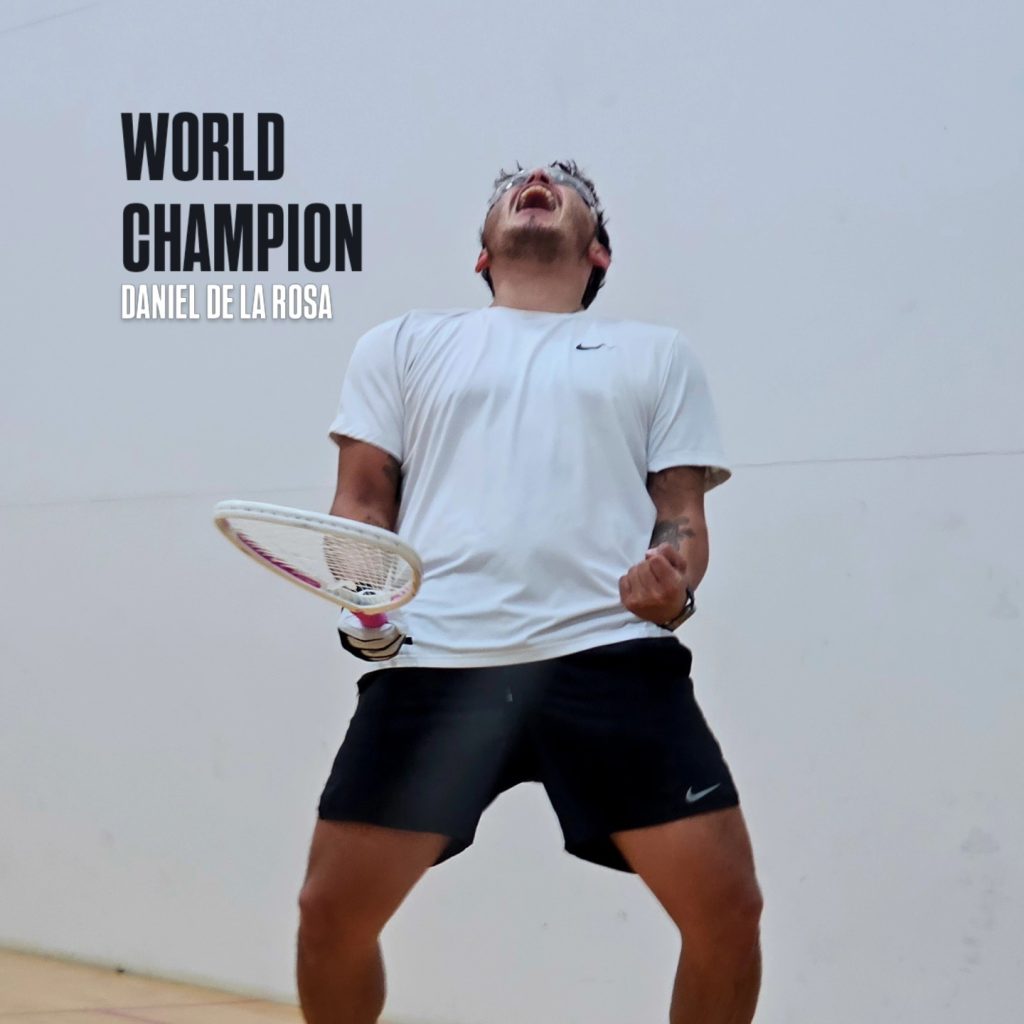
De La Rosa wins his first World singles title, gets the double with a Mixed title. Photo via IRF
The 22nd @International Racquetball Federation – IRF World Championships bracket events are in the books. Here’s a recap of the knockout stage action, along with links for the results as entered into the Pro Racquetball Stats database.
Congratulations to the winners:
– Men’s Singles: Daniel De La Rosa , USA
– Women’s Singles: Paola Longoria , Mexico
– Men’s Doubles: Samuel Murray & @Coby Iwaasa , Canada
– Mixed Doubles: Daniel De la Rosa & Hollie Scott , USA
Executive Summary: Great week for DLR, who goes undefeated and wins both Singles and Mixed. One has to wonder what would have happened if he had chosen to play Men’s doubles with his USA national championship winning partner Fernandez. Team Mexico does the double, winning both Women’s Singles and Doubles. Canada’s men’s doubles team continues to get results, making their 5th international final since 2019 and getting their second title. Bolivia is completely shut out after several cycles of multiple-win performances.
r2sports home page: https://www.r2sports.com/website/event-website.asp?TID=42436
Pro Racquetball Stats DB match results. Click on these links to see the match results for this event in the DB:
– Men’s Singles: https://rball.pro/8gq
– Women’s Singles: https://rball.pro/iby
– Men’s Doubles: https://rball.pro/v19
– Women’s Doubles: https://rball.pro/2l0
– Mixed Doubles: https://rball.pro/2gk
—–
For the rest of the event, they will play a “Team competition” davis-cup style where countries play singles and doubles as a team to advance; we’ll cover this and its World Games qualification import in an other post. Meanwhile, for decades all the individual play has historically resulted in separate “Team Standings” for IRF events. I’m not sure, with the advent of the team play recently, if IRF even maintains the Team Points results anymore … but we do for historical purposes. So…
Team Points Results From Knockouts
The “Team Standings” were determined by a standard algorithm that awarded points based on group stage and knockout performance.
(You can get these “team results” via queries available from the IRF singles page off of proracquetballstats.com historical site)
Combined Team (Overall)
1st – Mexico
2nd – USA
3rd – Bolivia
4th — Argentina
Mexico had the combined win sealed up even before any of the finals were played on thursday on the strength of their Women’s results. Bolivia edged Argentina for 3rd place by just four points, which is kind of ironic considering that Argentina’s entire team (Centellas, Garcia, Mendez, Miranda, and Vargas) all were born in Bolivia and switched allegiances to their South American Neighbor.
Men’s Team
1st – USA
2nd – Mexico
3rd – Bolivia
4th – Canada
USA’s dual-singles finals and Mexico’s early knockouts seal the Men’s title for USA.
Women’s Team
1st – Mexico
2nd – Argentina
3rd – Guatemala
4th – USA
Mexico nearly took maximum possible points for women, with 3 group stage wins and the singles title.
——-
Let’s run through the individual draws and talk about notable results.
Men’s Singles:
The Men’s singles knockout round went about as expected until the quarters … then all hell broke loose. I missed on 3 of the 4 quarter results in my prediction piece, headlined by the shock loss of the top seed and current IRT #1 Moscoso to Mexico’s #2 Portillo. USA’s #2 @Jake Bredenbeck had to go five to topple Argentina’s Garcia, and the infrequent touring pro Bolivian Carlos Keller Vargas took out Mexico’s Andree Parrilla. In the semis, Jake took out Lalo to get to the finals of an international competition the first time since 2016. There he met De La Rosa, who cruised past Keller in the other semi.
It was the first all-american final in an IRF event since 2015, and the first all-USA final in an IRF Major since 2010. Ironically, the last time Jake made an IRF singles final, his opponent was … De la Rosa as well. In the final, DLR ground out two game wins, then Jake caught fire and nearly donuted Daniel in the third before he caught fire in the fourth and pasted Jake 11-4 to claim the title. It’s Daniel’s first ever World title.
—
Women’s Singles:
The GOAT cruised into the final, topping the young Bolivian Rivero in the, then the hobbled Vargas in the semis. Meanwhile Guatemala’s Martinez beat USA’s Key in the opener, then beat former LPRT tour champ Mejia in the quarters in a match that included the single longest game (23-21) in IRF history, then she came from a game down to topple Chile’s Carla Munoz in the semis.
Longoria and @Ana Gabriela Martínez met in the Worlds final for the fourth time in the last five World Championships, and Longoria came out on top in the final to claim her 6th IRF World title. It’s also her 26th career IRF singles title, with wins dating all the way back to 2006.
—–
Men’s Doubles.
The #1 doubles team in the world (Montoya & Mar) was upset in Mexican Nationals this year by the #1 seed here (Parrilla & Portillo): they cruised into the title game with a 4-game win over team USA (Manilla & Fernandez) that wasn’t without a bit of controversy late. Meanwhile, Team Canada (Murray & Iwaasa), who have a habit of making it to the gold medal match internationally (they now have made 6 gold medal Men’s Pro Doubles matches since 2019), ground out two tough 5 game wins, including over Bolivia in the semis to ensure a medal-less event for the racquetball-rabid country, to get to the finals again.
In the final, Team Canada won a back and forth 5 game match where the momentum switched over and again.
—-
Women’s Doubles:
They had to work for it, but the dominant #1 pro doubles team of Mejia & Herrera came from behind in the 5th to win the five-game thriller over team Argentina (Vargas & Mendez) to claim the title. Its their third IRF title in the last two years.
—-
Mixed Doubles
Team USA’s De La Rosa would not be denied in San Antonio, as he took over for stretches to take the mixed title with partner Hollie Scott.
——
Congrats to the International Racquetball Federation for another successful event. Thanks to the IRT streaming crew, and thanks to @Gary Mazaroff and Gustavo and all his co-announcers for their hard work all week.
Next up on the Racquetball Calendar: https://docs.google.com/…/1V6OTid6rZ356voXVkoV2…/edit…
We’ll cover the IRF team event next week in another post. Then next weekend 9/8/24 is world Racquetball day, with shootouts and tourneys all over the country. Please consider supporting your event organizers by playing in one of these events. One of the biggest will be an outdoor event at Stratton Woods park in Northern Virginia with a lot of traveling talent for the Bolivian Open.
After that, we have the 3WallBall event with the introduction of World Team Racquetball in Las Vegas at the end of September.